
Improving De-escalation: Training Exercises That Work
By Lisa Chang
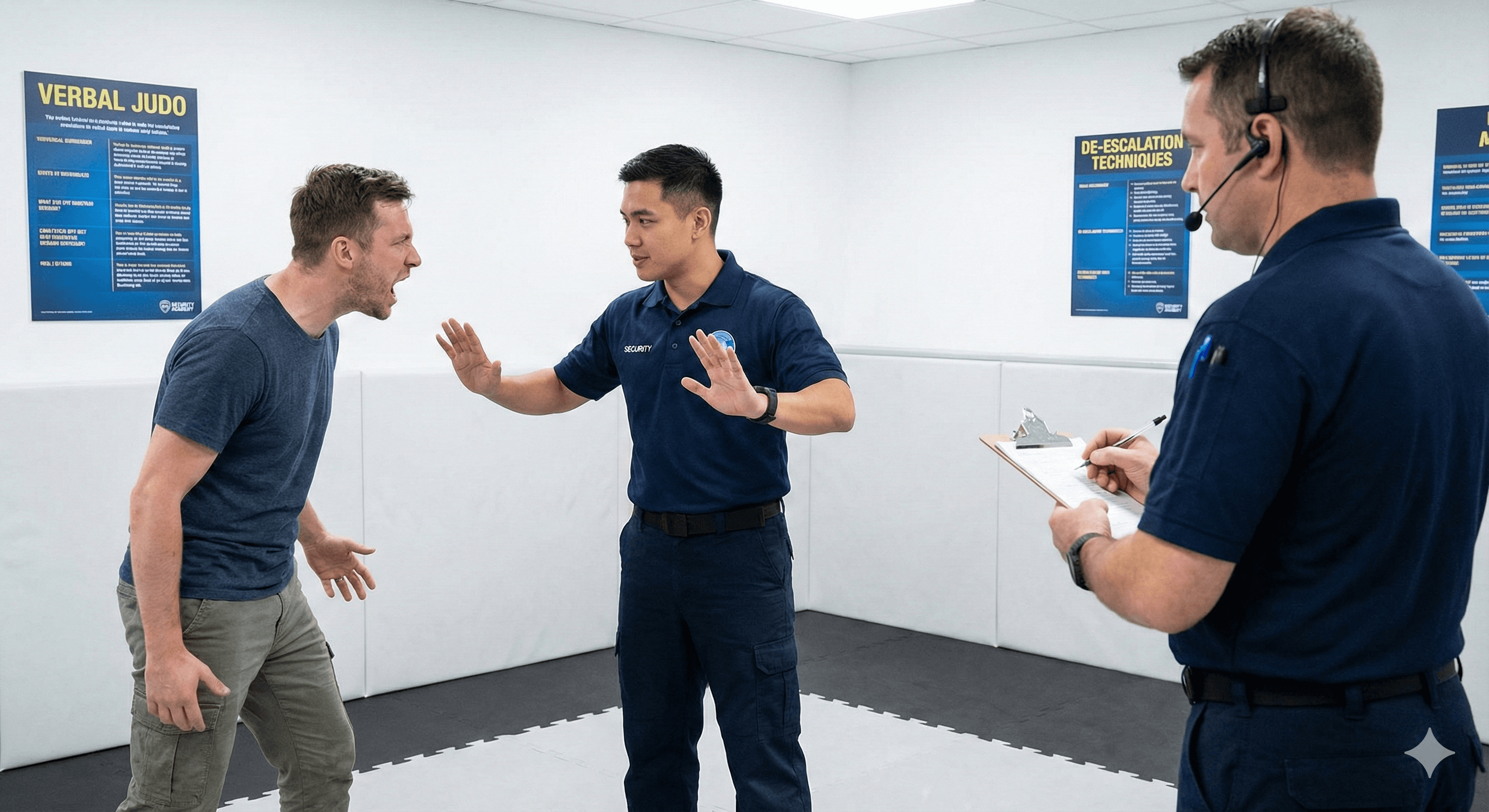
The best weapon a security officer has is their voice. Explore the specific role-playing scenarios and 'Verbal Judo' techniques we use to train officers to diffuse volatility without physical force.
In the security industry, a physical altercation is often viewed as a failure of strategy. While officers must be trained in self-defense, the ultimate goal is to never have to use it. At ProForce1, we emphasize that the most powerful tool on an officer's belt isn't the pepper spray or the baton—it's their ability to communicate.
1. The "Verbal Judo" Simulation
Based on the classic techniques developed by Dr. George Thompson, this exercise teaches officers to use words to redirect aggression.
The Drill: Instructors act as verbally abusive subjects, shouting insults and refusing instructions. The trainee must maintain a "professional face," ignore the insults, and loop the conversation back to the goal (e.g., "I understand you're upset, sir, but I still need you to step away from the door so we can help you.").
2. Proxemics and Stance Workshops
Body language speaks louder than words. If an officer says "calm down" while clenching their fists and puffing their chest, they are sending a mixed signal that escalates tension.
3. The "Why?" Loop Exercise
Often, people become aggressive because they feel unheard. This exercise focuses on active listening. Trainees are paired up; one acts as a distressed customer who has been denied entry. The officer must ask open-ended questions to uncover the root cause of the distress rather than just repeating "It's policy."
4. High-Stress Decision Making
It is easy to be calm in a classroom. It is harder when your heart rate is 140 BPM. We use physical exercises (burpees or sprints) to elevate the trainee's heart rate immediately before a role-play scenario. This simulates the adrenaline dump of a real confrontation, forcing the officer to find their calm voice despite physiological stress.
Better Training = Lower Liability
Security officers who know how to de-escalate reduce injury risks and legal liability for business owners. Choose a provider that prioritizes brains over brawn.