
What Is a BSIS Guard Card? Everything California Businesses Should Know
By Security Operations Team
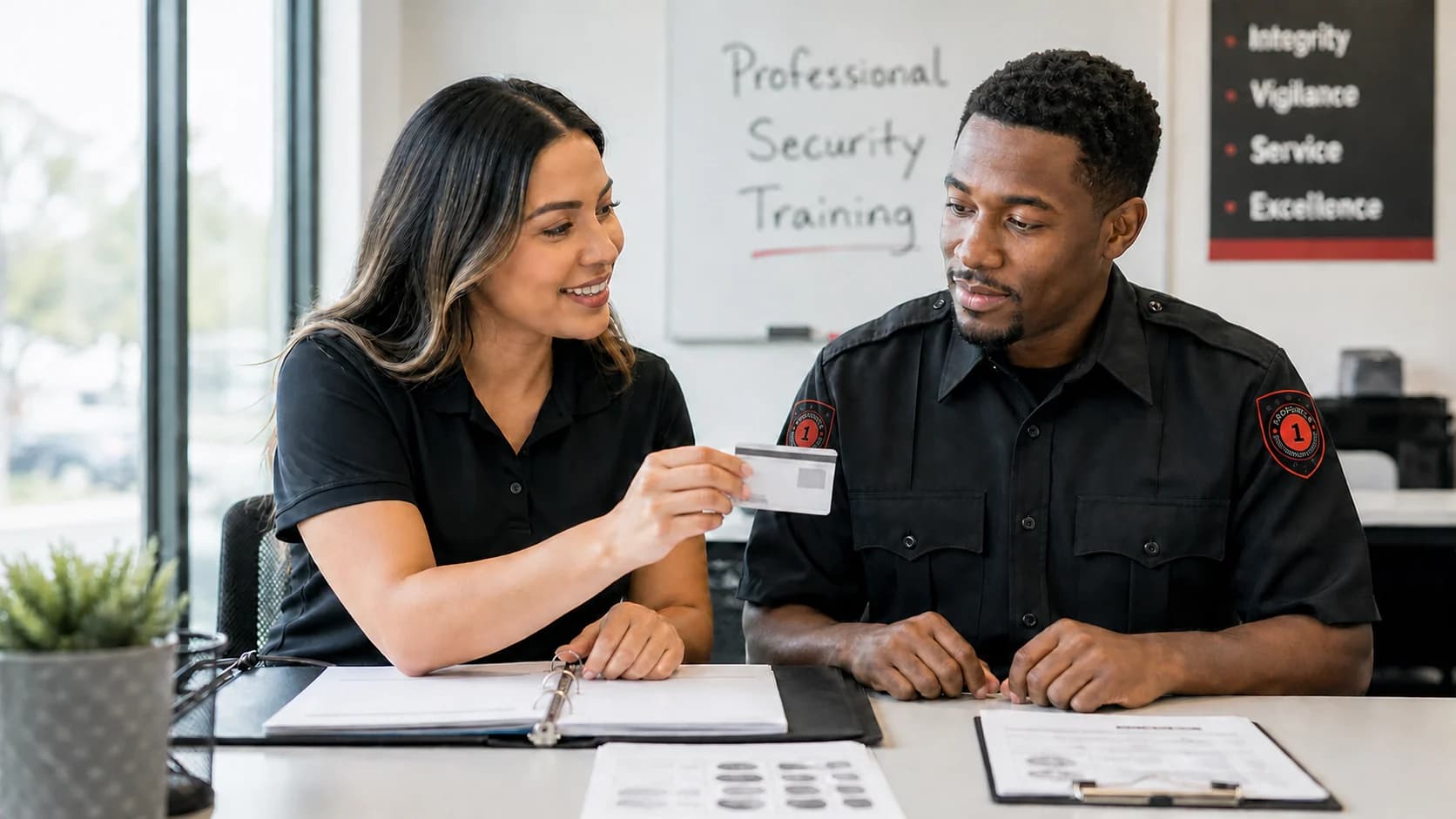
A BSIS Guard Card is a registration issued by California's Bureau of Security and Investigative Services (BSIS) for people working as security guards. In most cases, anyone performing unarmed security duties in California must have a valid Guard Card before starting work. For businesses, checking this credential is an important part of choosing qualified security personnel and maintaining proper compliance.
Why Does a BSIS Guard Card Matter to California Businesses?
Hiring a security guard may seem simple. You find a security company, discuss your property's needs, agree on a schedule, and expect the assigned officer to show up ready to work. But there is an important step that should never be overlooked: making sure the security personnel are properly registered and trained.
California regulates private security work through BSIS. The Guard Card is a fundamental credential that a person working in an unarmed security role receives. This will help to confirm the individual has completed the procedures necessary to be registered for this type of work, and the individual satisfies the basic requirements of the state.
This is relevant to a business owner in several instances. Employees, customers, contractors, visitors, vendors and the public are among the people with whom security personnel may come into contact. They can also be tasked with ensuring that entries are managed, incidents are recorded, restricted areas are monitored, suspicious activity is reported, and emergency services are called out if needed.
Any business looking into the service of one of the security providers should examine the following points as:
- Whether assigned guards are registered for B.S.I.S.
- If required training has been done or not.
- The suitability of the Guard for the level of security needed for the property.
- The effectiveness and efficiency of the security company in monitoring its employees' activities.
- If incident reports and security records are kept.
- If a scheduled guard is not in place, what provisions are there for replacement coverage.
Having a Guard Card does not mean that just any security officer will work on a particular property. But it's a major first step in determining whether a person has been trained to carry out unarmed security jobs in California.
How Does Someone Get a BSIS Guard Card in California?
Getting a California Guard Card involves several steps. An applicant is required to be approved for a qualifying security position after fulfilling the applicable BSIS requirements, training, application requirements, and obtaining fingerprints for background check purposes.
An 8-hour Power to Arrest and Weapons of Mass Destruction awareness training is one of the initial training requirements. This training should be completed during the initial process.
Training is ongoing beyond the initial training course. The state of California also mandates further training for security guards during the first year of service. In total, guards must complete 40 hours of training during their first year.
The process generally includes:
- Initial training: The applicant completes the required BSIS-approved training.
- Application: The applicant submits the Guard Card application with the required information.
- Fingerprinting: Fingerprints are submitted for the required Department of Justice and FBI background checks.
- Registration processing: BSIS reviews the application and background information.
- Ongoing training: Once working, the guard completes additional required training within the specified periods.
For businesses, this means a security officer's qualification should be checked before assigning them to a post. A company should not assume that someone is qualified simply because they have previous security experience.
What Training Does a California Security Guard Need?
Training is one of the most important parts of professional security work. A Guard Card is a registration credential, but guards also need the appropriate training to perform their duties safely and professionally.
California requires 40 hours of training during a security guard's first year. The training is spread across different stages rather than being completed entirely at once.
Topics may include areas such as public relations, observation and documentation, liability, communication, emergency procedures, and other subjects relevant to private security work.
Why does this matter to a business?
Imagine a security officer working at a busy shopping center. A disagreement suddenly starts between two people near an entrance. The officer needs to observe what is happening, communicate appropriately, avoid unnecessary escalation, document the incident, and contact law enforcement if the situation requires it.
The same principle applies at an apartment complex, construction site, warehouse, hospital, office building, or manufacturing facility.
Good security personnel should be able to:
- Identify and report suspicious behavior.
- Maintain accurate incident records.
- Communicate clearly with employees and visitors.
- Follow property-specific instructions.
- Respond appropriately during emergencies.
- Know when to contact police, fire departments, or emergency medical services.
- Maintain professional behavior throughout an assignment.
This is why businesses should look beyond the Guard Card when selecting a security provider. Registration is important, but training, supervision, experience, and site-specific preparation also matter.
Is a BSIS Guard Card the Same as an Armed Security License?
No. A standard BSIS Guard Card is associated with unarmed security work. It does not automatically authorize someone to carry a firearm while performing security duties.
Armed security assignments involve additional requirements. Businesses that believe they need armed protection should discuss the specific requirements with a properly licensed security provider and confirm that assigned personnel have the necessary authorization and qualifications.
A retail store may primarily need an unarmed guard to monitor entrances, deter theft, assist with access control, and report incidents. A construction site may need guards to monitor equipment, materials, gates, and after-hours activity. A commercial facility may require scheduled patrols rather than a stationary guard.
Before selecting a provider, ask:
- What type of security personnel will be assigned?
- Are the guards currently registered with BSIS?
- Does the assignment require armed or unarmed personnel?
- What training does the assigned officer have?
- Who supervises the guard?
- How are incidents reported?
- What happens if an officer cannot attend a scheduled shift?
These questions can help a business avoid choosing a service based only on price.
What Can Happen If a Business Uses an Unqualified Guard?
A business may assume that licensing and training are entirely the security company's responsibility. While licensed security providers have their own legal obligations, businesses should still take reasonable steps to confirm that the personnel assigned to their property are properly qualified.
An unqualified or improperly registered guard can create operational and compliance concerns. There is also a practical issue: an inadequately prepared guard may struggle during a serious incident.
Think about a security officer working overnight at a commercial property. A door alarm goes off, an employee reports suspicious activity, or an unauthorized person is found inside the building. The officer needs to know how to respond, communicate, document what happened, and contact the appropriate authorities.
Businesses should therefore consider several factors before selecting a provider:
- Verify the Guard Card registration.
- Review the company's licensing information.
- Ask about employee training.
- Confirm the provider has experience with similar properties.
- Discuss emergency procedures.
- Establish clear reporting expectations.
- Confirm how replacement officers are handled.
For properties where fire protection systems are unavailable, impaired, or specific fire-related conditions require additional monitoring, businesses can consider Fire Watch Security Services as part of their security plan.
For properties that need regular perimeter checks, vehicle patrols, or after-hours monitoring, Mobile Patrol Security Services may provide a practical alternative to keeping an officer stationed at one location continuously.
How Can Businesses Verify a BSIS Guard Card?
Businesses should verify security credentials instead of relying only on a photograph or photocopy of a Guard Card. California provides an online license-verification system through BSIS where businesses can check registration information. This gives employers and security clients a better way to confirm whether a credential is current.
When reviewing a guard's credentials, businesses should check the person's name, registration information, and current status. It is also useful to ask the security company to confirm that the assigned employee has completed the training required for the position.
A simple verification process can include:
- Requesting the guard's registration details.
- Checking the information through the official BSIS system.
- Confirming that the registration is current.
- Asking the security provider about required training.
- Keeping relevant documentation for vendor records.
- Reviewing credentials again if the guard's role changes.
What Should California Businesses Look for in a Security Provider?
A valid Guard Card is a starting point, but businesses should look at the complete security service before signing an agreement. Start by identifying what actually needs protection. Is the main concern unauthorized access? Theft? Vandalism? Employee safety? After-hours activity? Fire-related risks? Perimeter security?
For a small commercial property, an unarmed security guard may provide sufficient coverage. A construction site may benefit from a combination of stationary security and mobile patrols. A property that requires temporary fire monitoring may need fire watch personnel. A higher-risk location may require appropriately licensed armed security officers.
What Is the Best Security Option for a California Business?
There is no single security solution that works for every California business. A valid BSIS Guard Card is an essential credential for qualifying unarmed security work, but businesses should consider the larger picture before choosing a provider. For routine access control, employee and visitor monitoring, and general property protection, trained unarmed guards can be a practical choice. For large properties that need regular perimeter checks, mobile patrol can provide broader coverage. For locations dealing with fire-related risks, fire watch services may be more appropriate. Businesses facing higher security risks should discuss whether armed security is legally and operationally suitable for their property. For California businesses, the Guard Card is the baseline. The right personnel, proper supervision, clear procedures, and a security plan built around the property's needs are what turn that baseline into dependable protection.
Need Qualified Security Coverage?
ProForce1 provides licensed, trained security personnel and protection plans built around your property, operating requirements, and risk profile.
Request a Security Assessment